Behind the Scenes of the Mission Intelligence Insight Engine

By Andrew Humphrey
At Mission Inc., we believe every executive, manager, and team lead should have immediate, uncluttered visibility into the metrics that matter. Strategic decisions demand more than dashboards: they require timely insights, surfaced even when no one thought to ask for them. That’s why our new AI-driven Mission Intelligence Insight Engine (MIIE) system, Mission Intelligence, pairs generative AI with a suite of precisely engineered functional tools to highlight trends, flag anomalies, and deliver context-rich analysis that supports proactive, data-driven leadership.
MIIE brings powerful internal tooling straight to a conversational interface. Instead of digging through pages of reports or spreadsheets, user scan now access data-analysis actions directly through a dashboard chatbot that blends AI with deterministic tools, understands intent, triggers the right workflows, and returns clean, structured results. It’s a home-grown engine —fast, extensible, and built to slot into our existing infrastructure — wrapped in a human-friendly layer that makes advanced data operations as simple as asking a question.
The system is engineered from the ground up to provide results that are robust, explainable, and consistently reliable — not the improvisation you’d expect from a typical chatbot. At its core is a clean division of roles: the conversational layer extracts intent, the planning agent turns that intent into an actionable plan, and the execution engine runs the plan step-by-step to deliver a dependable outcome.
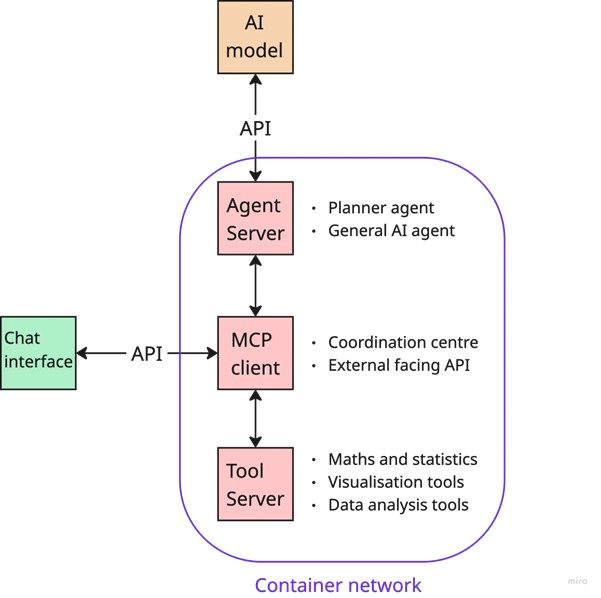
Let’s take a deep dive into how MIIE works. The chat interface is the user’s gateway to this realm of data exploration and insights. Here, they can type their question or analysis request in plain language, without needing any specialised computing or mathematical knowledge.
Behind the scenes, when a user submits a question, it triggers an AI-based agent that analyses the message to determine whether it can be answered by RAG alone or whether the advanced capabilities of Mission Intelligence are required. The agent also refines the message as needed for more efficient processing in the backend.
In the Mission Intelligence backend, the incoming request is parsed and sent to an AI-driven planning agent. Using strict guidelines, this agent evaluates the request, checks which tools are available, and creates a plan to satisfy it. The plan is structured so that our execution engine can step through each stage, combining intermediate results as necessary to arrive at the final output. Crucially, this process is fully transparent and provides complete explainability and auditability when required.
The internal functions of Mission Intelligence were developed to combine the power of AI-based understanding and orchestration with the safety and computational efficiency of deterministic tool functions. While language models excel at interpreting and generating natural language, they are generally not cost-effective or reliable for analysing numerical datasets, such as those commonly found in organisational dashboards. To solve this, Mission Intelligence includes a suite of fixed tool functions that perform specific data-analysis and visualisation tasks. These tools are deterministic: the same input will always produce the same output.
Strictly speaking, these tool functions are not entirely fixed. Some include parameters that can be tuned by the planning agent within carefully predefined limits, providing flexibility while ensuring users always receive reliable, trustworthy results. In the rare case that the right tool does not already exist, the planning agent can either offload the task to an externally hosted AI model or generate a new tool on the fly.
The Mission Intelligence backend also hosts a dedicated component that monitors system activity and proactively suggests improvements to the toolset and agent behaviours. It uses frontier-level AI to generate proposals for new tools, which are then reviewed by a human operator. This system-evolution algorithm has two main advantages over a static, one-size-fits-all approach. First, it evolves alongside the business: optimising queries, refining workflows, and identifying missing analytical functions before they become bottlenecks —something static systems simply cannot anticipate. Second, it reduces cognitive load for users by learning how people actually interact with the system and shaping its responses, defaults, and workflows around those patterns, eliminating the friction that static systems leave for users to navigate.
Another key feature of the Mission Intelligence architecture is the custom, type-safe protocol that governs how information moves between the conversational layer, planning engine, agents, and deterministic tools. Built on rigorously defined Pydantic models and served through Fast API endpoints, every message follows a strict, validated schema designed specifically for multi-component workflows. Each component receives exactly the data it expects, while the protocol also enables efficient discovery of available tools and execution nodes, allowing the system to route tasks intelligently. Queries, plans, intermediate results, datasets, and execution context are all serialised through this unified, strongly typed contract, eliminating ambiguity and reducing the risk of silent failures. By combining precision with discoverability and tailoring to our workflow, this communication layer keeps the system transparent, debuggable, and resilient, enabling complex, multi-step operations to run efficiently and reliably.
If you’re interested in how this architecture is being applied in practice, or are working through similar technical constraints, you can get in touch with our technical teams via our contact us page.





Ready to Transform Your Organisation?
Take the next step towards aligning your leadership team and driving growth with Mission Inc.
Schedule a consultation with our team to discuss how we can help you achieve long-term success.